The UK Graduate visa has been one of the biggest reasons students choose a UK master's: finish your degree, then stay and work. That is changing. From 1 January 2027 the UK Graduate visa drops to 18 months for most graduates. If you are studying in the UK now, or planning a UK master's for 2027, the date you apply could decide whether you get 2 years or 18 months.
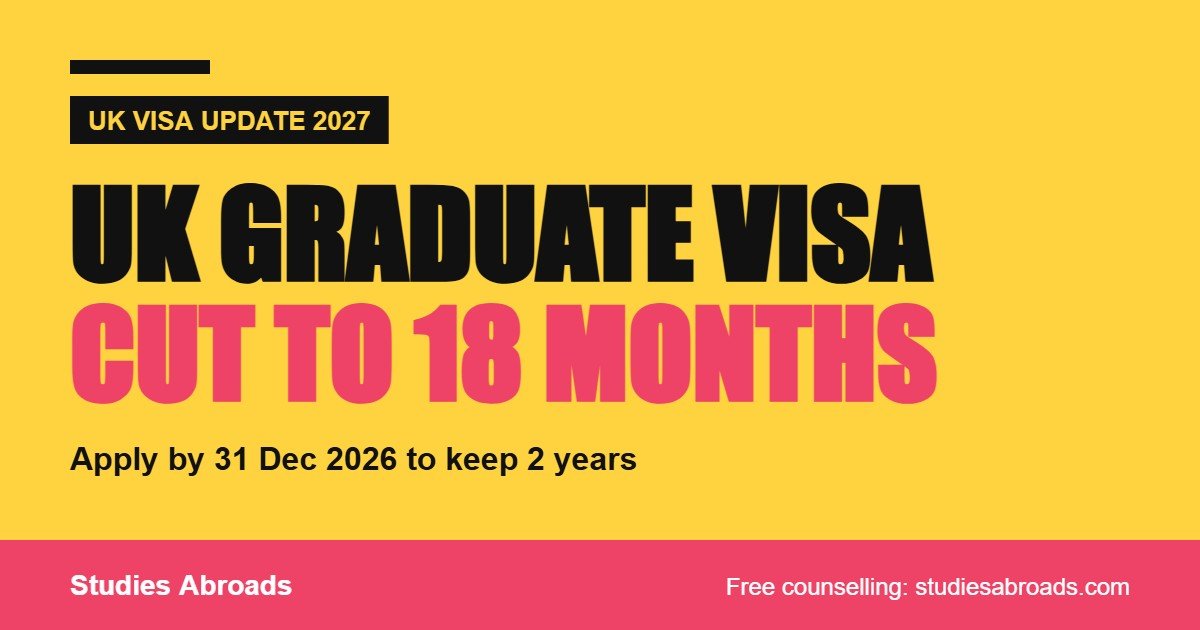
Quick answer: If you apply for the Graduate visa on or before 31 December 2026, you get 2 years. If you apply on or after 1 January 2027, bachelor's and master's graduates get 18 months. PhD and other doctoral graduates still get 3 years. What counts is the date you apply, not the date you graduate.
Planning a UK master's or deciding between countries? Book a free 1:1 counselling call or message us on WhatsApp.
What is the UK Graduate visa?
The Graduate visa (also called the Graduate Route or post-study work visa) lets international students stay in the UK after a successful degree. You can work, look for work, or switch to another visa. You do not need a job offer or a sponsor to get it.
According to GOV.UK, you can apply if you are in the UK on a Student visa and your university has told the Home Office you have successfully completed an eligible bachelor's, postgraduate, or other course.
What exactly changes on 1 January 2027?
- Bachelor's and master's graduates: 2 years becomes 18 months for applications made on or after 1 January 2027.
- PhD and doctoral graduates: no change, still 3 years.
- Applications made before 1 January 2027: not affected. You keep 2 years.
The UK government announced the cut in its May 2025 immigration white paper and confirmed it in October 2025 changes to the Immigration Rules. Several UK universities, including the University of Salford, have published guidance for students explaining the switch.
Does the date I graduate or the date I apply matter?
The date you apply. This is the most important point in this guide. A student who finishes a master's in September 2026 and applies in November 2026 gets 2 years. A student who finishes at the same time but waits until January 2027 to apply gets 18 months.
You can apply once your university has reported your course completion. GOV.UK says you do not need to wait for your graduation ceremony or certificate. Your Student visa must still be valid and you must apply from inside the UK.
I finish my UK course in late 2026. What should I do now?
- Check your official course end date and when your university will report completion to the Home Office.
- Ask your university whether they can report completion as soon as your results are confirmed.
- Prepare your documents early: passport, BRP or eVisa details, and your CAS number.
- Budget for costs: GOV.UK lists a £937 application fee plus the Immigration Health Surcharge, usually £1,035 for each year of your stay. Check GOV.UK before paying, because fees change.
- Apply before 31 December 2026 if you are eligible and want the full 2 years.
Is a UK master's still worth it with an 18-month Graduate visa?
For many students, yes, but plan differently. Most UK taught master's programs take one year, so the total time can still be shorter and cheaper than a two-year program elsewhere. What changes is how fast you need to move on your career:
- Start your job search during your degree, not after it.
- Target employers who sponsor the Skilled Worker visa, since the Graduate visa cannot be extended.
- Use internships and placements to build UK experience early.
- If research is your goal, a UK PhD still comes with 3 years of post-study time.
Weighing the UK against other countries? Read our UK vs Canada comparison and our guide to the best alternatives to studying in the USA.
Starting a UK master's in 2027? What this means for you
If you are applying now for a September 2027 or January 2027 intake, you will almost certainly finish your course after 1 January 2027. That means planning for an 18-month Graduate visa from day one. A one-year master's starting in September 2027 typically ends around September 2028, which gives you post-study time until about early 2030, depending on when your visa is approved.
Use that time well: choose a course with a placement or internship option, pick a city with strong employers in your field, and build your CV and LinkedIn profile before you arrive.
Can I extend the Graduate visa or bring family?
You cannot extend a Graduate visa. You may be able to switch to another visa, such as the Skilled Worker visa, before it ends. GOV.UK says your partner and children may be able to stay with you on this visa if they are eligible. Check the GOV.UK rules for dependants before you plan.
Frequently asked questions
Will I get 2 years if I graduate in 2026 but apply in 2027?
No. Applications made on or after 1 January 2027 receive 18 months, even if you finished your course in 2026.
Does the 18-month rule apply to PhD students?
No. PhD and other doctoral graduates still receive 3 years.
Do I need a job offer for the UK Graduate visa?
No. You do not need a job offer or a sponsor to apply.
How long does a Graduate visa decision take?
GOV.UK says decisions usually take up to 8 weeks, and you can stay in the UK while you wait.
Can I apply from outside the UK?
No. You must be in the UK on a valid Student visa when you apply.
Plan your UK study and work route with us
An 18-month Graduate visa still opens doors if you plan ahead. Book a free 1:1 counselling call or WhatsApp us, and explore our Study in the UK guide. Getting ready for your English test? Try our free practice page. You can also contact us anytime. Prefer video? Watch our explainers on our YouTube channel: Studies Abroads.
General guidance, not legal advice. Rules as of November 2026; always check GOV.UK before you apply.
📞 +1 346-381-4680 | WhatsApp +91 9108713003 / +91 9108713005 | 🌐 studiesabroads.com