
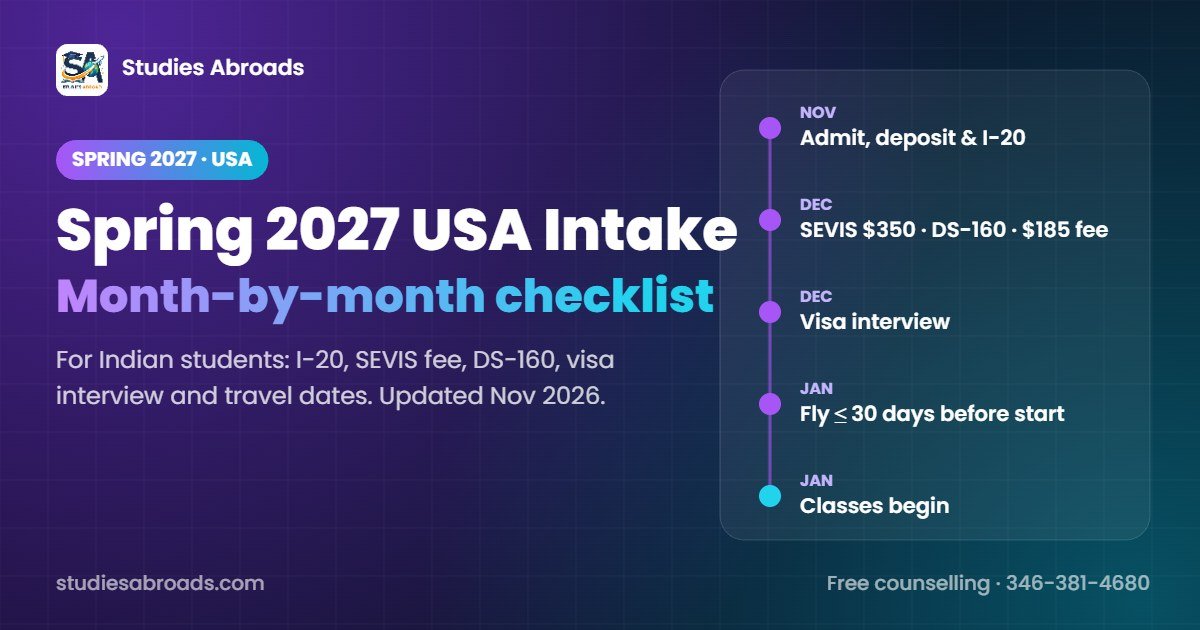
Quick answer (as of November 13, 2026): Most US universities closed their Spring 2027 applications for international students between August and November 2026, but some programmes still admit on a rolling basis. If you already have an admit for January 2027, you have about eight weeks to finish everything: I-20 → SEVIS fee ($350) → DS-160 → visa fee ($185) → interview → travel. You can enter the US up to 30 days before the start date on your I-20.
This guide gives Indian students a month-by-month plan for the January 2027 intake, the current fees, the 2026 visa rules that are catching people out, and what to do if you can't get a visa slot in time.
Is it too late to apply for Spring 2027?
For most universities, yes. International deadlines for January 2027 mostly fell between August and November 2026. For example, UIC Business set September 1, 2026 as its Spring 2027 international deadline. International applicants often have earlier deadlines than US applicants, because the university needs time to issue the I-20.
A few programmes still review applications on a rolling basis until their seats fill. If you don't have an admit yet:
- This week: email the graduate admissions office of 3–5 shortlisted programmes and ask, "Are you still accepting international applications for Spring 2027, and can an I-20 be issued in time?"
- If the answer is no: switch your plan to Fall 2027. Most Fall deadlines run from December 2026 to March 2027, and Fall has more scholarships and assistantships.
Spring 2027 month-by-month checklist
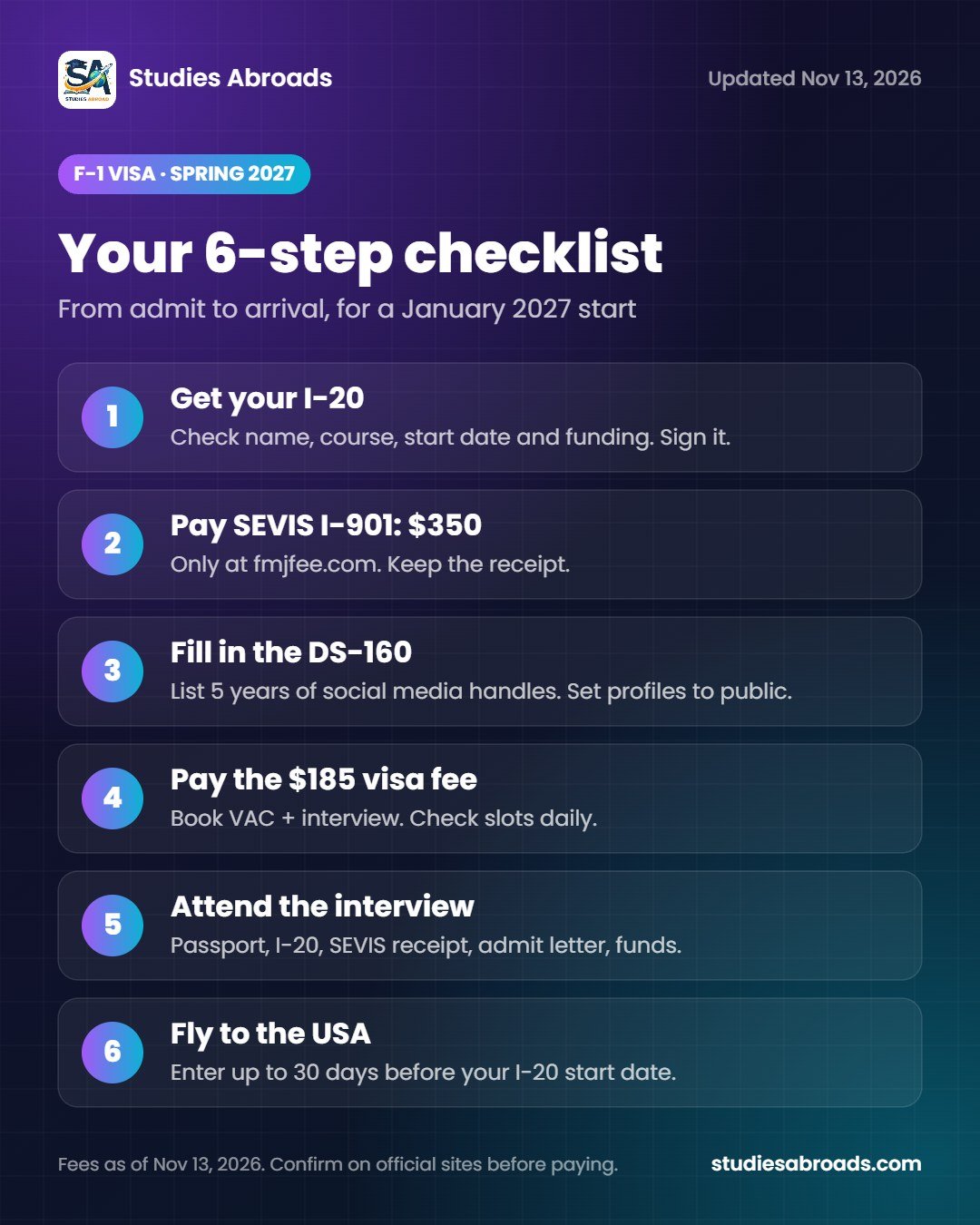
November 2026: lock your admit and I-20
- Accept your offer and pay any enrolment deposit the university asks for.
- Send your financial documents (bank statements, education loan sanction letter, sponsor affidavit). They must cover at least the first-year cost shown on the I-20.
- When the I-20 arrives, check that your name matches your passport, the programme and start date are right, and the funding section adds up. Sign it.
- Make sure your passport is valid for at least 6 months beyond your planned stay.
Late November to December 2026: fees, DS-160 and interview
- Pay the SEVIS I-901 fee ($350) only at the official site, fmjfee.com, using the SEVIS ID (starts with "N") on your I-20. Save the receipt.
- Fill in the DS-160 at ceac.state.gov. List every social media handle you have used in the last five years.
- Set your social media accounts to public. Since June 2025, the US Embassy in India has asked all F, M and J applicants to do this so their profiles can be vetted.
- Pay the $185 visa application (MRV) fee and book your Visa Application Centre (biometrics) and interview slots.
- Prepare for the interview: why this university, why this course, how you will pay, and your plans after graduation.
January 2027: travel and start classes
- You can enter the US up to 30 days before the programme start date on your I-20. Earlier than that and you can be refused entry.
- Carry your passport, visa, signed I-20, SEVIS receipt, admit letter and financial documents in your hand luggage, not in checked bags.
- Report to your university's international student office as soon as you arrive. They have to register you in SEVIS.
F-1 visa fees for Spring 2027
| Fee | Amount | When you pay |
|---|---|---|
| SEVIS I-901 fee | $350 | After you get your I-20, before the interview (ICE) |
| Visa application (MRV) fee | $185 | Before booking the interview (US State Department) |
| Visa Integrity Fee | $250 | Set by a US law signed on July 4, 2025. Some consulates began collecting it in 2026, but collection has not been the same everywhere. Check the official fee page close to your interview date. |
All of these fees are non-refundable if your visa is refused, so check your documents before you pay. Budget separately for flights, your first month's rent and health insurance.
Visa rules that are catching students out in 2026
- In-person interviews. Since September 2, 2025, interview waivers have been sharply limited. Plan on attending an interview in person.
- Public social media. A private or locked profile can delay your case. Go through your old posts before you make accounts public, and make sure the handles match your DS-160.
- Scarce slots in India. F-1 appointments were frozen for months and only began opening again in April 2026, in small, irregular batches. Check the booking portal every day and keep your documents ready so you can grab an earlier slot.
- 221(g) administrative processing. Some applicants are told their case needs extra checks after the interview. If this happens, reply quickly to any document request and tell your university, because it can push your arrival past the start date.
What if you can't get a visa before January?
- Ask your university about the latest arrival date it allows. Some let students arrive a week or two after classes begin.
- If you can't make it, ask the university to defer your admission to Summer or Fall 2027 and issue an updated I-20. You can usually reuse your SEVIS fee payment if the university updates the same SEVIS record (not a new one). Check with the university's international office.
- Don't book non-refundable flights until your visa is in your passport.
Spring vs Fall: which intake suits you?
| Spring (January) | Fall (August/September) | |
|---|---|---|
| Programmes open | Fewer, mostly master's and some MBA/MS courses | Almost all programmes |
| Scholarships and assistantships | Limited | The most funding |
| Competition | Often lower | Highest |
| Summer internship | Only one semester before recruiting starts | A full year before your first internship |
Spring works well if you have a strong profile, your funding sorted, and you want to start sooner. Choose Fall if you need a scholarship or assistantship, or want more time to prepare.
Need help with your Spring or Fall 2027 plan?
Studies Abroads helps students shortlist universities that still accept applications, check I-20 and funding documents, and prepare for the F-1 interview. Book a free counselling call or read our guides on the SEVIS fee, F-1 interview questions and common interview mistakes.
Fees and rules change often. Information is current as of November 13, 2026. Always confirm on the official ICE, US State Department and US Embassy India websites before you pay or travel.


